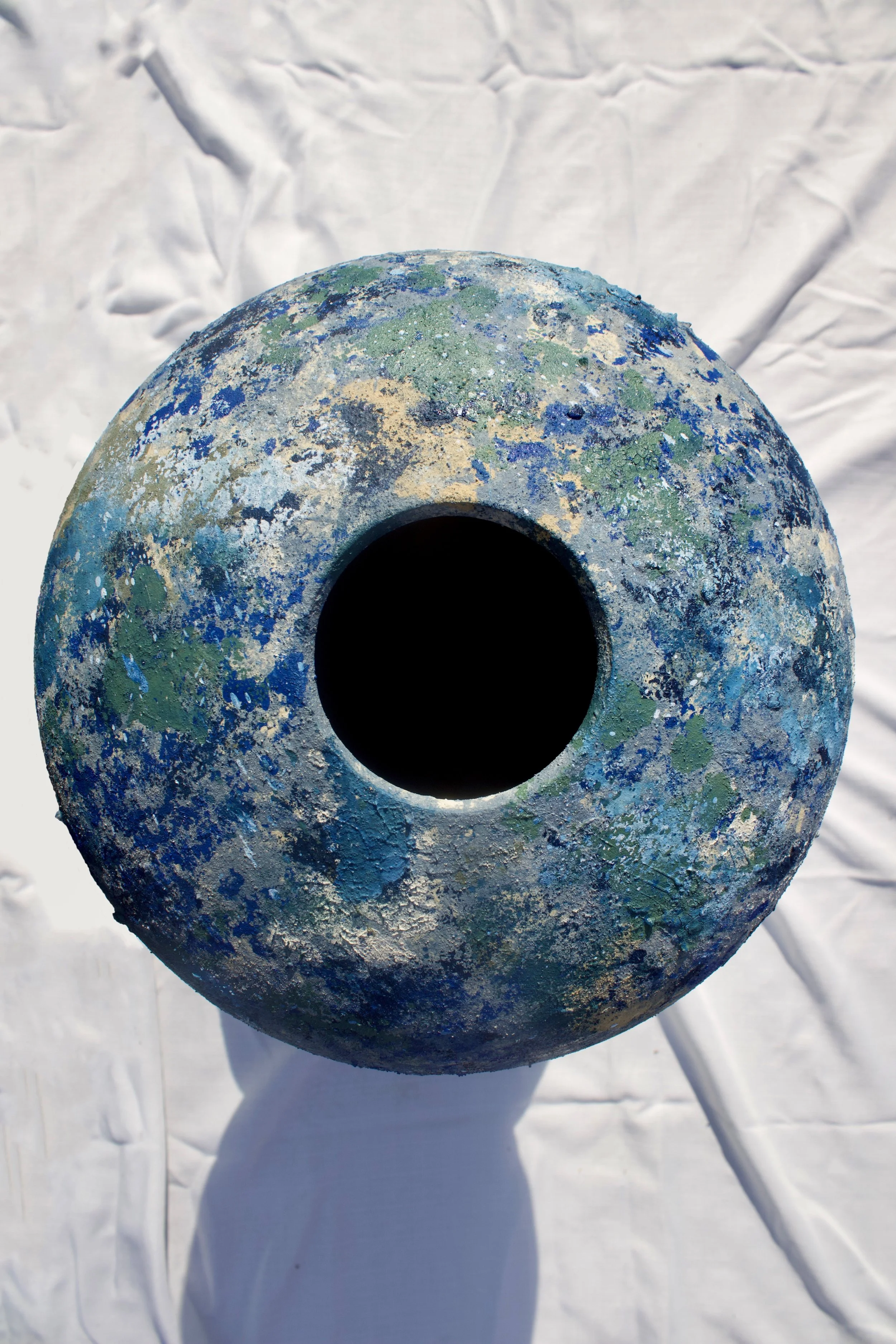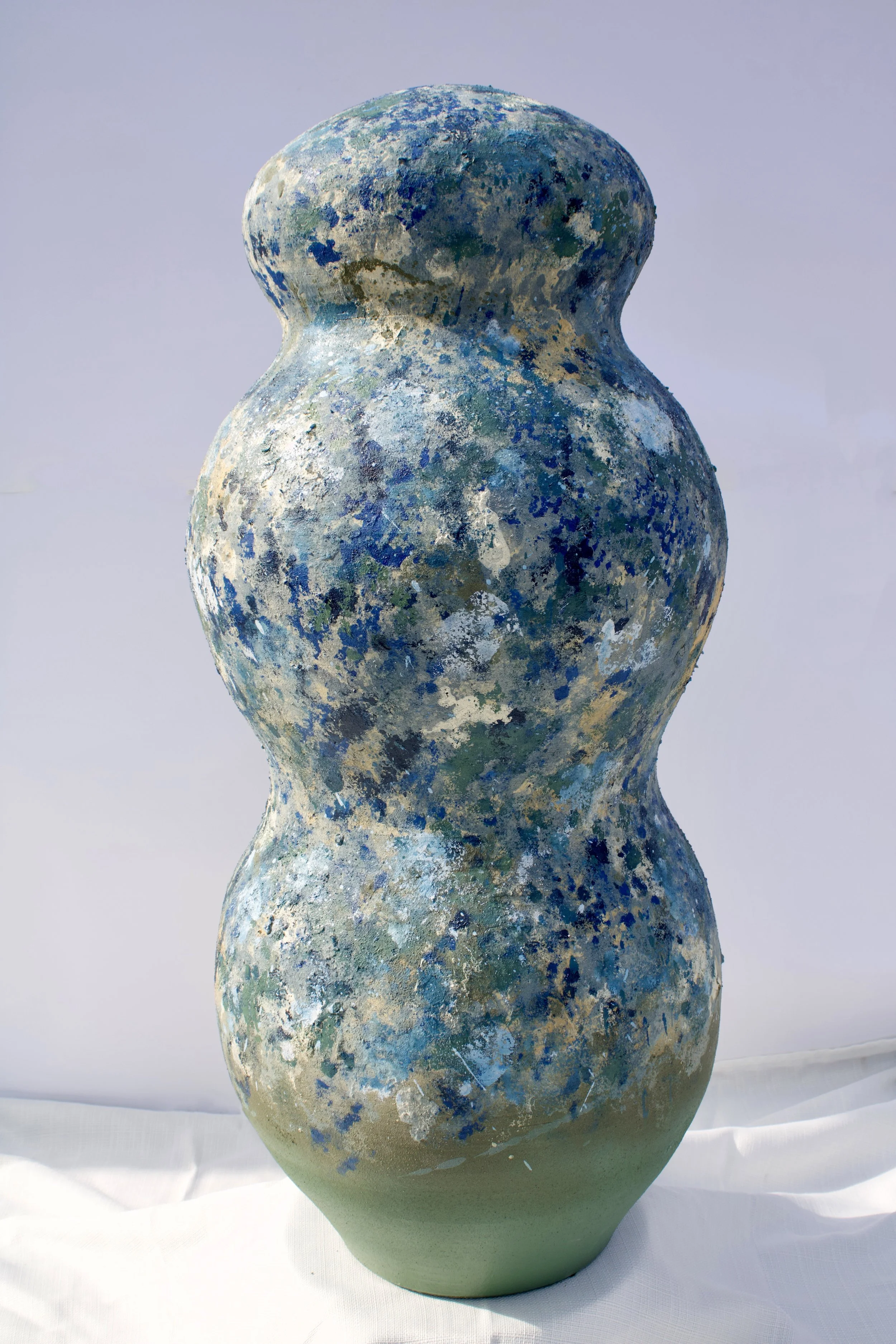
My work lives at the intersection of architecture, ceramics, and performance art. Across medium, physical practice, artwork, and philosophy, three is a recurring theme. I distort, extend, and compress three-bellied “Monoliths” informed by Buddhist trikāya frameworks. Each Monolith mirrors a distorted human form.
I push both the clay and my body to their physical limits with each construction.
My series “Chasing Giants” is predicated on the idea of “sandcastles in the city.” I make temporary monuments to highlight our ever-growing reluctance to enjoy a given moment—prioritizing the physical act in deference to finished objects. Therefore, I intentionally destroy each piece as a method of not only placing importance on the practice, but also release. Each destruction informs the construction of the next artwork.
The act of throwing is central to my practice, as I have never differentiated the physical act of throwing from the construction of mountains, valleys, oceans, etc. Two hands forming a clay wall mirror the collision of tectonic plates. The centrifugal force of the wheel and the Earth are uniform. Gravity acts as the final adjudicator.
That said, when I choose to fire the work, my surface application references the atmospheric conditions each Monolith ruminates within.
Artist Statement
It’s eerily ironic. As a kid I first wanted to be an astronaut, then a marine biologist, psychologist, and finally a therapist. I landed in a medium where I could combine all those passions from youth. I always smirk when I rehash the thought of it all because it was never about the subject matter per se—it was the fact that each subject danced with exploration.
The core of my practice has always been rooted in pure exploration—where nothing is known but failure and observation. Often, that diverges into pushing boundaries: “How far can the clay be pushed before it buckles? How many hours can I balance focus, physical stamina, and decision making? Is my torch going to set off another fire alarm?”
All of these questions (mostly) are recurring whenever I throw. Consistently conversing with clay has developed an intuition baked into the Wetlock Method—a proprietary throwing method that allows for architectural-scale ceramic pieces.
I purposefully pushed hundreds of forms to collapse because success taught me nothing. To truly explore what I didn’t know, I had to make what I thought was impossible—and study that failure to correct my next attempt.
In both practice and execution, much of my methodology is influenced by Buddhist and Quaker philosophies. Listening to the clay has always been paramount in deference to a final piece. However, I came to realize that the explorative through-line was, at times, the final piece.
Practice Statement